You Can't Go Home Again: The Cruel Paradox Facing Every Small-Town Star Who Made It Big
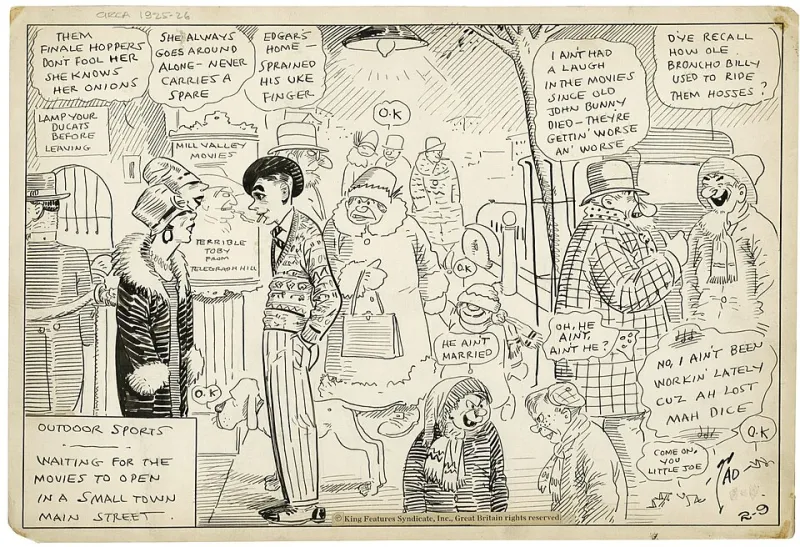
Photo: Tad Dorgan, Public domain, via Wikimedia Commons
You Can't Go Home Again: The Cruel Paradox Facing Every Small-Town Star Who Made It Big
There is a version of the celebrity origin story that never gets old. You know it by heart. The star sits across from a late-night host, or gives a profile interview to a major magazine, and at some point the conversation turns to where they came from. A small town. A modest house. Parents who worked hard. Not much money, but a lot of love. The star's voice softens. They talk about how grounded it keeps them, how they still remember where they came from, how they could never forget the person they were before all of this.
It's a great story. It's also, for most of them, completely inaccessible in any practical sense — because the moment you become famous enough to tell that story on a national platform, the place you're describing no longer exists in the way you're describing it.
This is the hometown hero trap. And it closes the second the first magazine cover drops.
The Origin Story as Brand Asset
Humble beginnings are among the most valuable commodities in celebrity culture. They create relatability, which creates affection, which creates the kind of loyal fanbase that sustains a career through the inevitable rough patches. A star who came from nothing is, in the public imagination, fundamentally more trustworthy than one born into privilege — they earned it, they understand struggle, they're still, somehow, one of us.
Publicists and brand managers understand this intuitively. The small-town origin story gets emphasized in early career profiles, woven into award acceptance speeches, referenced in song lyrics and album liner notes. It's not necessarily dishonest — most of these stars did come from modest backgrounds, and that shaped them in real ways. But it's also a deliberate brand choice, a positioning decision made with the same strategic care as a fragrance deal or a film role selection.
The problem is that brand assets are static. The story stays the same. The person — and their circumstances — do not.
The Gap That Keeps Growing
Consider what actually happens to a person's relationship with their hometown when they become famous. First, the practical reality: they no longer live there. They can't, really. The infrastructure of a major celebrity's life — the team, the studio access, the industry relationships, the security requirements — is incompatible with small-town living. They move to Los Angeles or New York or wherever the work is, and that move is permanent in all but the most theoretical sense.
 Photo: New York, via www.hdwallpapers.in
 Photo: Los Angeles, via upload.wikimedia.org
Then there's the financial gap. A star who grew up in a working-class household and now earns eight figures a year inhabits a fundamentally different material reality than the people they grew up with. This isn't a moral failing — it's just arithmetic. But it creates a distance that no amount of goodwill can fully bridge. You can go back to visit, but you can't go back to belonging.
And then there's the most uncomfortable gap of all: the social one. The people who knew the star before the fame have a complicated relationship with who they've become. Some are proud. Some are resentful. Some have been burned by the experience of being mentioned — or misrepresented — in interviews or songs or social media posts. The hometown is full of people with opinions about the famous person who used to live there, and those opinions are not always flattering, and they are definitely not always private.
The Authenticity Debt
Here's where it gets genuinely tricky. The star has built a public identity around a place and a version of themselves that is increasingly hypothetical. Fans who connected with that identity — who felt seen by it, who found comfort in the idea that someone like them could make it — have an emotional stake in its continued validity. They need the star to still be, in some essential way, the person from that small town.
This creates what might be called an authenticity debt: an ongoing obligation to perform a version of yourself that you can no longer fully inhabit. Every red carpet appearance in a $20,000 outfit, every vacation on a private yacht, every home renovation special — all of it chips away at the origin story, and all of it has to be managed carefully to avoid the accusation that you forgot where you came from.
Some stars handle this by doubling down on the narrative. They film content at their parents' old house. They talk about their hometown in every interview. They make conspicuous donations to local causes. These gestures are often genuine — but they're also, inevitably, performances of a relationship that has fundamentally changed.
Others simply stop talking about it, which creates its own problems. Silence reads as erasure. Fans who once felt represented by the star's origins feel abandoned when those origins stop being referenced. The hometown becomes a liability by omission.
The Visit That Never Goes Quite Right
Ask anyone who has covered celebrities for any length of time, and they'll tell you about the hometown visit gone sideways. The carefully arranged return trip that turns into a logistical nightmare — crowds, security, the local news showing up, the childhood friends who feel like strangers, the places that have changed beyond recognition or, worse, haven't changed at all.
These visits are almost always documented, because of course they are — the hometown return is a powerful piece of content, a visual confirmation of the origin story's continued relevance. But they're also almost always quietly awkward in ways the finished content doesn't capture. The star is a tourist in their own history. The town has moved on, or it hasn't, and either way there's a grief in it that doesn't make it into the Instagram caption.
The Story That Outlasts the Truth
Perhaps the most poignant dimension of the hometown hero trap is that the fans' version of the star's origin story often becomes more real, more detailed, and more emotionally significant than the star's own memory of it. Fans research the hometown. They visit it. They build entire imaginative worlds around it. The small town becomes a kind of mythology, tended and expanded by people who have never been there.
And the star, who actually grew up there, who remembers the specific texture of it — the complicated parts, the boring parts, the parts that weren't charming at all — has to watch their actual past become someone else's romantic fantasy.
You can be from somewhere and still be a stranger to it. In Hollywood, that's not a tragedy — it's a career.
The small town will always be in the bio. Whether it's still in the bones is a question only the star can answer — and they're almost never asked to answer it honestly.